
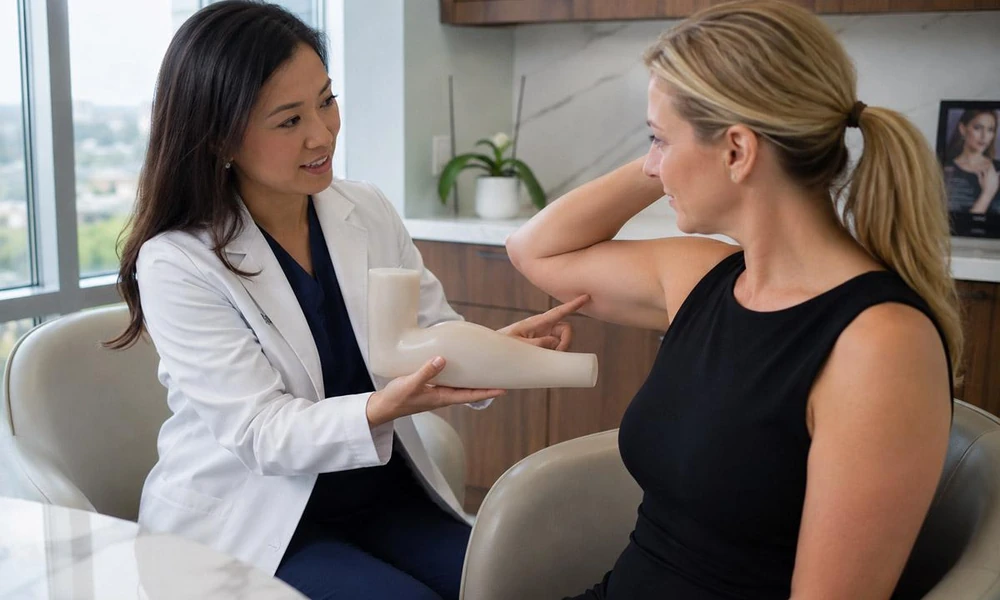
Loose, sagging upper arm skin, often called “bat wings,” doesn’t respond to diet or exercise because once skin has stretched and lost elasticity, no amount of muscle toning underneath will tighten it back up. Arm lift surgery (brachioplasty) surgically removes the excess skin and fat to create a smoother, more toned arm contour.
You can build muscle underneath loose arm skin all you want, but if the skin itself has lost its elasticity, exercise alone won’t make it snap back, which is exactly why so many patients turn to arm lift surgery after trying everything else.
Why Exercise Doesn’t Fix Loose Arm Skin
The muscle can get stronger. The skin covering it can’t get tighter on its own.
Once skin has been stretched, whether from significant weight loss, aging, or genetics, it loses much of its natural elasticity and doesn’t reliably contract back to its original shape, even after the underlying fat or weight is gone. Building arm muscle through exercise can improve tone underneath, but it can’t correct skin that has already lost its resilience, which is why persistent “bat wing” tissue often requires a surgical solution.
What Causes Loose Upper Arm Skin
The most common causes are significant weight loss, including after bariatric surgery, combined with the natural loss of skin elasticity that comes with aging. Genetics also play a meaningful role in how much skin laxity someone develops and how well their skin responds to weight changes over time.
What Arm Lift Surgery Involves
Brachioplasty removes excess skin and fatty tissue from the upper arm, typically through an incision along the inner or back of the arm from the underarm area down toward the elbow, and tightens the remaining tissue for a smoother, more contoured result. In cases with less skin excess, a shorter-scar technique limited to the underarm area may be appropriate instead of the full-length incision.
Who Tends to Be a Good Candidate
Good candidates have excess, sagging upper arm skin that hasn’t improved with diet and exercise, are at or near a stable weight without planning major fluctuations, are in overall excellent health, don’t smoke, and have realistic expectations about the resulting scar in exchange for a smoother arm contour.
What Recovery Looks Like
Initial recovery involves swelling, bruising, and some discomfort for the first one to two weeks, with most patients returning to non-strenuous activities within that window. Full arm strength and more strenuous activity are typically reintroduced gradually over four to six weeks, with the resulting scar continuing to fade and flatten over the following months to a year.
If loose upper arm skin has resisted your best efforts at diet and exercise, board-certified plastic surgeon Dr. Siamak Agha can discuss whether an arm lift is right for you during a consultation in Newport Beach.
Ready to explore arm lift surgery? Schedule a consultation with board-certified plastic surgeon Dr. Siamak Agha at The One Plastic Surgery Center in Newport Beach to discuss your goals and options.
Results and candidacy vary by patient. A consultation is required to determine your individual suitability for any procedure discussed in this article.
FAQ
Why won’t exercise fix loose upper arm skin? Once skin has stretched and lost elasticity, it doesn’t reliably contract back on its own, so building muscle underneath it doesn’t correct the loose skin itself.
What causes bat wing arms? The most common causes are significant weight loss and the natural loss of skin elasticity with aging, with genetics also playing a meaningful role.
What does arm lift surgery involve? It removes excess skin and fat from the upper arm through an incision, typically along the inner or back of the arm, and tightens the remaining tissue.
Is there a shorter-scar option for arm lift surgery? Yes, patients with less skin excess may be candidates for a shorter-scar technique limited to the underarm area rather than a full-length incision.
How long is recovery after an arm lift? Initial recovery takes one to two weeks, with strenuous activity gradually reintroduced over four to six weeks and the scar continuing to improve over the following months.